One server runs the AI. Your Odoo stays thin.
The 360 AI server is itself an Odoo instance. It holds the providers, prompts, agents and logs, and manages every connected customer environment. The client module on your Odoo is deliberately AI-free: it calls the hub and renders results.
- Per-environment API keys + user keys
- Metadata sync: models, fields, users, languages
- Production + child test environments
- MCP relay at
/x360mcp
The model sees what you allow. Field by field.
Every prompt is bound to a schema: an explicit selection of which fields, relations and context (message history, activities, attachments) get serialized to the model. Not "the record", but the fields you chose, with hidden fields that never leave Odoo.
Field-level allowlists per model, explicit or additive, with hidden fields and controlled recursion into relations. Privacy and token cost, managed in one place.
Usage tracked per provider connection, with a configurable backup provider when the primary fails.
Action logs on every AI run, timed agent executions, Logfire instrumentation. When someone asks what the AI did, you can show them.
Supervised agents defer writes to an approval queue. AI decision cards land in a systray inbox on the client for review.
Datasets (including synthetic), LLM-as-judge scoring from 0 to 10 with reasoning, side-by-side provider comparison. Prompt changes get graded before they ship.
UI-callable tests exercise the live LLM integrations as background jobs, so upgrades don't silently break AI features.
Three MCP surfaces, one standard.
360 AI speaks MCP in all three directions.
Odoo as MCP server
The ai_360_mcp module puts an MCP server on your Odoo instance itself: /ai360mcp serves nine odoo_* typed tools, with OAuth 2.0 sign-in (PKCE, dynamic client registration, refresh tokens) or per-user bearer keys. Calls run as the authenticated user.
The hub as MCP relay
The /x360mcp endpoint on the 360 AI server relays seven x360_* tools to any connected environment, behind environment + user keys, model and method allowlists. The full story is on the MCP page.
Agents as MCP clients
Register any external MCP server (SSE or streamable HTTP) and its tools join the agent toolset, next to the native Odoo tools.
Two endpoints, two homes: /ai360mcp lives on your instance; /x360mcp fronts every connected environment from the hub.
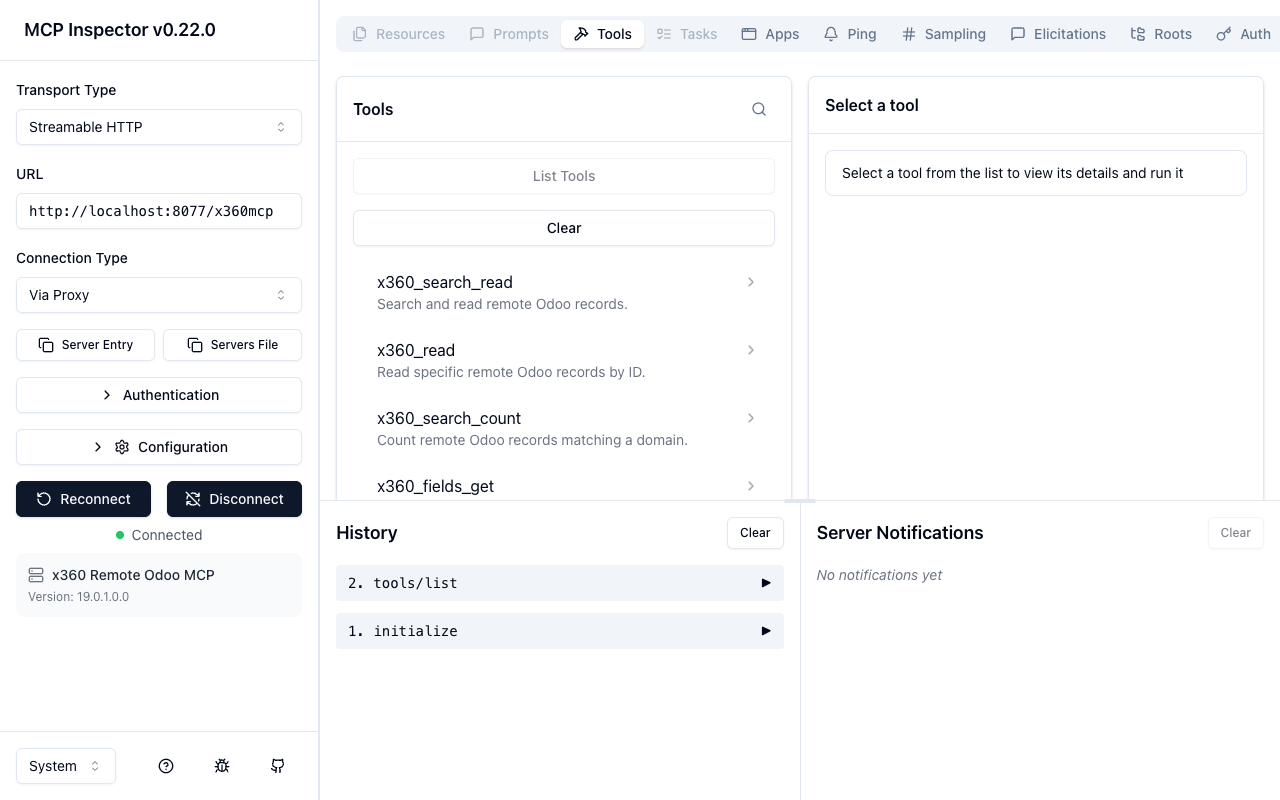
/x360mcp relay: connected, its seven x360_* tools listed, version 19.0.1.0.0.Boring where it should be.
No exotic runtime. Odoo modules, a job queue, pydantic-ai for the agents, and code you can read.
Bring your architect.
We like the hard questions.
360 ERP runs the platform and implements it. Ask for a technical deep-dive session and bring the person who says no.
Talk to 360 ERP